

In der letzten Zeit sind u.a. diese frei verfügbaren Titel erschienen:
Beards and texts: images of masculinity in medieval German literature
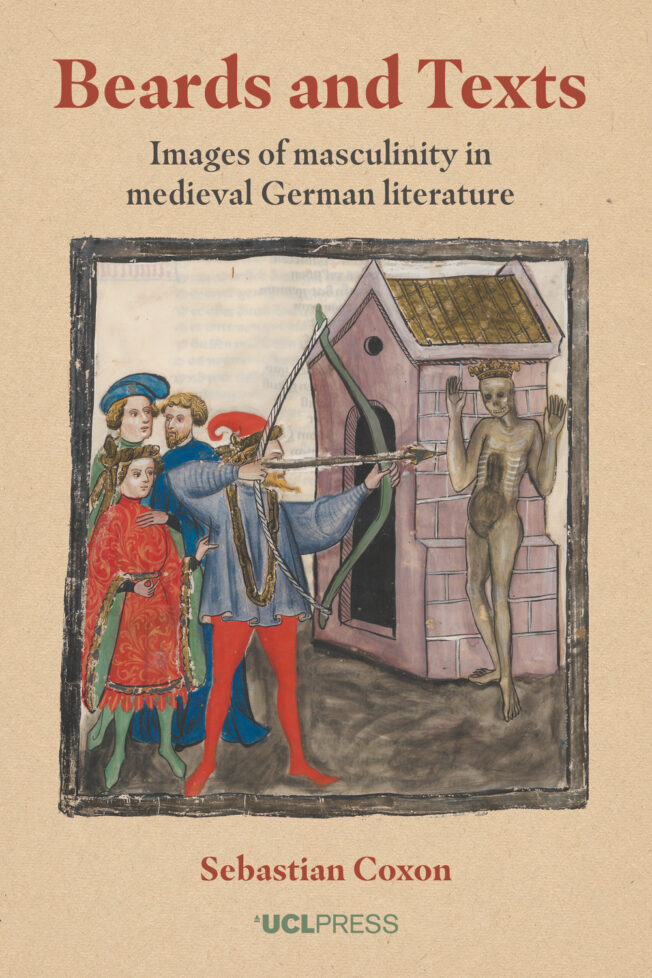
Sebastian Coxon
https://doi.org/10.14324/111.9781787352216
https://uclpress.co.uk/book/beards-and-texts/
Beards and Texts explores the literary portrayal of beards in medieval German texts from the mid-twelfth to the early sixteenth centuries.
It argues that as the pre-eminent symbol for masculinity the beard played a distinctive role throughout the Middle Ages in literary discussions of such major themes as majesty and humanity. At the same time beards served as an important point of reference in didactic poetry concerned with wisdom, teaching and learning, and in comedic texts that were designed to make their audiences laugh, not least by submitting various figure-types to the indignity of having their beards manhandled.Four main chapters each offer a reading of a work or poetic tradition of particular significance (Pfaffe Konrad’s Rolandslied; Wolfram von Eschenbach’s Willehalm; ‘Sangspruchdichtung’; Heinrich Wittenwiler’s Ring), before examining cognate material of various kinds, including sources or later versions of the same story, manuscript variants and miniatures and further relevant beard-motifs from the same period.
The book concludes by reviewing the portrayal of Jesus in vernacular German literature, which represents a special test-case in the literary history of beards.As the first study of its kind in medieval German studies, this investigation submits beard-motifs to sustained and detailed analysis in order to shed light both on medieval poetic techniques and the normative construction of masculinity in a wide range of literary genres.
How to create an early German scriptus: The literization approach to historical German syntax
Katerina Somers
https://doi.org/10.5281/zenodo.13836979
https://langsci-press.org/catalog/book/460
This book presents a new methodology for the study of historical varieties, particularly a language’s early history. Using the German language’s first attestations as a case study, it offers an alternative to structuralist approaches to historical syntax, with their emphasis on delineating the shapes and mechanisms of early grammars. This focus has prompted Germanists to treat the data from the eighth- and ninth-century corpus with suspicion in that its texts are either poetic or translational. That is, if the unquestioned object of inquiry is a historical cognitive grammar, one ought to isolate – and perhaps discount entirely – data that are the product of confounding factors, like a poetic meter or a Latin source text. Otherwise, these competence-obscuring examples risk undermining scholars’ understanding of a genuine early German grammar.
Rather than this “deficit approach,” the current volume proposes that scholars treat each early attestation as an artifact of “literization,” the process through which people transform their exclusively oral varieties into a written variety. Each historical text features a scriptus, that is, an ad hoc, idiosyncratic, and localized literization created by a person (or team of people) for a particular purpose. The challenge of understanding texts in this way lies in the fact that there is little to no direct evidence pointing to the specific identities of early medieval literizers, their motivations, and the nature of the multiple spoken competencies that fed into their scripti.
In order to conceptualize early medieval German and the syntactic variation it exhibits as a sociolinguistic phenomenon, this book details the linguistic resources that were available to the literizer and are, happily, accessible to the modern researcher. First, there is Latin. Though illiterate in their own multilectal vernacular in the sense that no German scriptus existed until they developed it, literizers were educated in this highly literized language and the classical metalinguistic discourse, known as grammatica, that was associated with it. Second, there are the linguistic patterns of elaborated orality, that is, the varieties that are characteristic of public life and the oral tradition in exclusively oral communities. Though the patterns of a peculiarly German elaborated orality are lost to history, those of other traditions and cultures are attested and should also inform how scholars conceive of a multilectal early German.
Retextualisierung und Innovation: Alt und Neu im Rappoltsteiner Parzifal

Julia Kermer
https://doi.org/10.5283/epub.59186
Mit seinem unvollendet gebliebenen Roman ‚Perceval‘ ruft Chrétien de Troyes zahllose Fortsetzer und Bearbeiter auf den Plan, die den Artus-Gral Stoff unterschiedlich ausgestalten: In der französischen Tradition verbindet sich mit dem Gral das Ende der Artuswelt. Wolfram von Eschenbach dagegen, der mit seinem ‚Parzival‘ den Gralsmythos in die deutsche Artusepik einführt, verleiht der Geschichte ein happy ending.
Diese beiden Traditionen führen Claus Wisse und Philipp Colin im Auftrag Ulrichs von Rappoltstein zusammen. Der ‚Rappoltsteiner Parzifal‘ verbindet dabei Retextualisierung mit Innovation: Seine Autoren schaffen allein durch die sorgfältige Kombination von Texten und das methodische Hinzufügen von Paratext neuen Sinn.
Von entscheidender Bedeutung ist die Einteilung des Werks in einen ‚alten‘ und einen ’neuen Parzifal‘. Sie illustriert, wie sich aus den wolframschen Ambivalenzen eine Krise des Artusrittertums, schließlich aber auch die Überwindung dieser Krise durch die Gralsuche entwickelt.
Schreibe einen Kommentar