

In der letzten Zeit sind u.a. diese frei verfügbaren Titel erschienen:
Language Landscapes: The ESL teacher’s guide to how English works
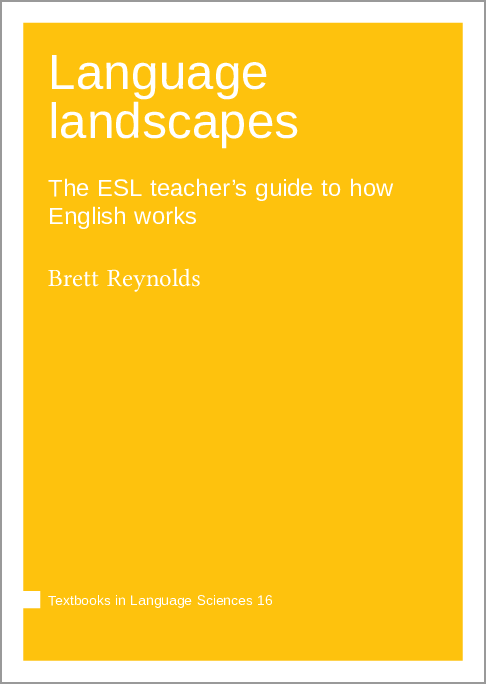
Brett Reynolds
https://langsci-press.org/catalog/book/555
https://doi.org/10.5281/zenodo.20612113
Language landscapes is a practical map of English for TESL educators, built around form–meaning pairings and the needs of real classrooms.
Adopting a CGEL-informed framework, it stabilizes the category – function distinction (e.g., determinatives vs determiner function), pares back overloaded labels (especially in the adverb/preposition space), and introduces syntax trees as a teacher’s analytic lens rather than a student exercise.
Early chapters address standards and normativity alongside a usable model of grammaticality; the book then moves through phonology (with Southern Ontario reference vowels and connected-speech processes), vocabulary (frequency, distribution, deliberate practice), orthography and phonics, and high-utility constructions (questions, negation, relatives). Later chapters treat information packaging, coherence and cohesion, pragmatics and conversation (including digital turn-taking), and fluency across skills, connecting analysis to instructional decisions and trade-offs with accuracy. Throughout, the book foregrounds counter-example reasoning, common TESL pitfalls, and modular sequencing so instructors can enter via fluency/discourse, sound/writing, or grammar proper.
The approach is functionalist and usage-aware, emphasizing community conventions, processing pressures, and change over time; trees and constructional patterns are tools for understanding, not ends in themselves. With concise diagnostics (e.g., NICER properties of auxiliaries), worked examples, glossaries, and cross-references, Language landscapes helps teachers say more with fewer rules – and better justify what to teach, when, and why.
Pragmatics in Contested Interpretation: Varied Audiences, Varied Implicatures, Varied Inferences
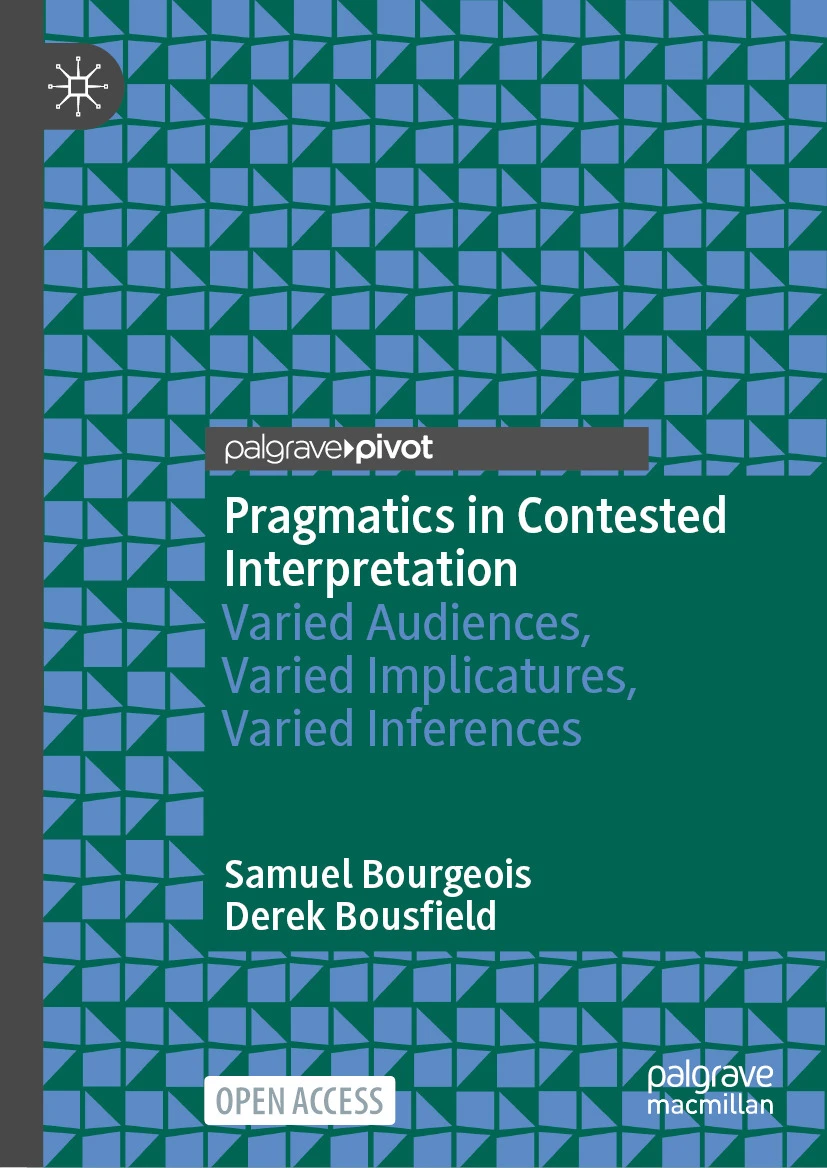
Samuel Bourgeois & Derek Bousfield
https://doi.org/10.1007/978-3-031-95345-3
This open access book explores the mechanisms by which different audiences hearing the same comments made by the same speaker in the same context come to different interpretations as to the meanings behind them.
The study uses a ‘pragmacognitive’ approach that fuses insights from sociopragmatics and critical discourse analysis to examine both the speaker’s intentions and the audience’s reactions. The authors explore the role and construction of context through a pragmacognitive analysis of two controversial utterances made by Donald Trump during the 2020 and 2024 presidential election campaigns and one controversial comment from President Joe Biden’s short-lived 2024 re-election campaign. They analyse in detail how these comments have been interpreted by those receiving their words within the wider political context of a highly politicised and divisive campaign, inferred by some to constitute problematic insulting behaviours and/or calls for violence while others have found them to be playful political critiques.
The authors emphasise how indeterminate language, activity type conventions, and the respective identities and reality paradigms of the speakers contribute to creating varied audiences with ‘contested interpretations’. Contested interpretations are particularly apparent in cases where ambiguous, hyperbolic, or even metaphorical language is used to simultaneously conduct face-attack against individuals and organizations, and appeal to a political base of supporters.
This book contributes to the growing body of scholarship in this area and will be of interest to a multidisciplinary audience including readers in linguistics, political rhetoric, and political discourse.
Tracing the history of pronunciation in nineteenth-century English
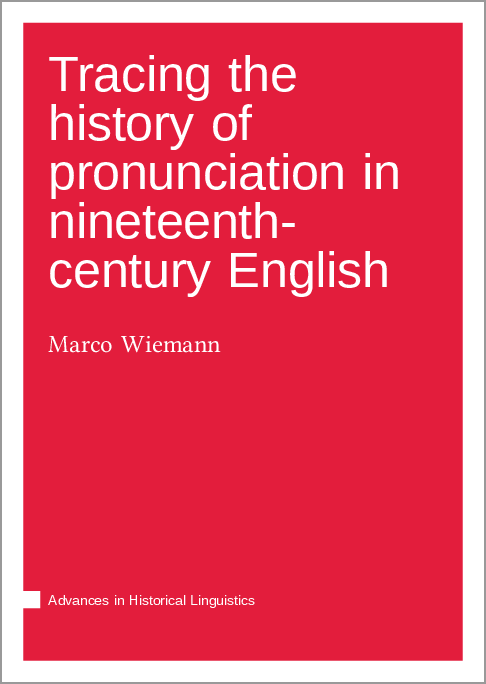
Marco Wiemann
https://langsci-press.org/catalog/book/553
https://doi.org/10.5281/zenodo.20309582
A key challenge of studying the historical phonology of any language is how to reconstruct the pronunciation of periods before the availability of sound recording. Many studies of pre-twentieth-century pronunciation rely on sources that comment on how people spoke, or infer pronunciation from spelling variation or rhymes. This book is the first to investigate the phonology of nineteenth-century English based on a new kind of written source material: it examines pronunciation evidence provided by contemporary grammar books, and offers quantitative and qualitative analyses of the phonological commentary found in a collection of 258 English grammars published in Britain, Ireland, and North America during the nineteenth century.
The nineteenth century has been described as the century of prescriptivism, and this book examines the tensions between prescriptive and descriptive approaches in the grammars. Individual case studies detail several linguistic features which were undergoing change and which were reportedly stigmatised at the time. Consonantal features include non-rhoticity, /h/-dropping and /h/-insertion, the WHICH-WITCH merger, /v/-/w/ interchange, and the pronunciation of –ing. Further studies chart variation in the vowel of BATH words, and in the diphthongs of words such as FACE and GOAT, which are characteristic of both RP and American English pronunciation. In exploring the potential of this understudied source material as evidence of historical pronunciation, this book contributes to the fields of historical phonology, grammaticography, the study of prescriptivism, and historical sociolinguistics.

Schreibe einen Kommentar