
In der letzten Zeit sind u.a. diese frei verfügbaren Titel erschienen:
Comparative morphology across categories: Ukrainian adjectives, adverbs, and deadjectival verbs

Anastasiia Vyshnevska
https://doi.org/10.48273/LOT0693
This dissertation investigates comparative morphology in Ukrainian adjectives, adverbs, and deadjectival verbs. The comparative suffix in Ukrainian has two allomorphs: -š, as in molod-š-yj ‘younger’, and –iš, as in vesel-iš-yj ‘merrier’. I claim that the allomorph –iš is in fact comprised of two morphemes, –i and –š. I account for the comparative allomorphy in terms of root sizes using Nanosyntax. Big roots like molod take only one comparative morpheme, while smaller roots like vesel take both comparative morphemes. These are simple adjectives, which consist of the root, the comparative morpeme(s) and the agreement marker. There are also complex adjectives, which have an additional morpheme following the root. Considering both simple and complex adjectives, the main theoretical proposal of this dissertation is that Ukrainian adjectives come in seven different root sizes (and shapes), corresponding to seven different empirical patterns. The size of the root depends on the amount of morphology present in the comparative: the less morphology a comparative adjective takes, the bigger its root is. These seven adjectival root sizes derive both adverbs and deadjectival verbs. Ukrainian deadjectival verbs show a unique pattern, where the verbs productively and systematicaly contain comparative morphology.
Complex Words, Causatives, Verbal Periphrases and the Gerund: Romance Languages versus Czech (A Parallel Corpus-Based Study)

Olga Nádvorníková, Pavel Štichauer, Petr Čermák, Dana Kratochvílová (Hrsg.)
https://directory.doabooks.org/handle/20.500.12854/43660.2
The monograph focuses on the typological differences between the four most widely spoken Romance languages (Spanish, Portuguese, French and Italian) and Czech. Utilizing data from InterCorp, the parallel corpus project of the Czech National Corpus, the book analyses various categories (expression of potential non-volitional participation, iterativity, causation, beginning of an action and adverbial subordination) to discover differences and similarities between Czech and the Romance languages. Due to the massive amount of data mined, as well as the high number of languages examined, the monograph presents general and individual typological features of the four Romance languages and Czech that often exceed what has previously been accepted in the field of comparative linguistics.
Elementa universalis linguae Slavicae, translated with commentary and introductory essays
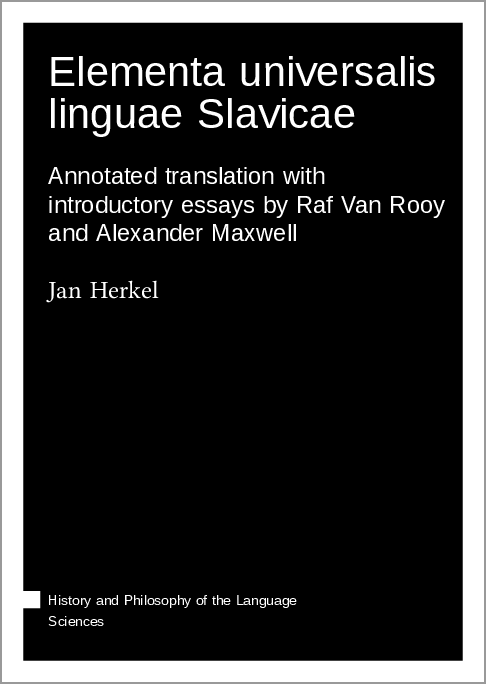
Jan Herkel
https://langsci-press.org/catalog/book/399
https://doi.org/10.5281/zenodo.13773949
In 1826, as nationalism first began percolating through the Habsburg lands, Jan Herkel published a Latin-language Slavic grammar. Herkel, a lawyer and amateur linguist, came from the northern counties the Kingdom of Hungary which now form the Slovak Republic. Though he was inspired by a romantic love of his native language, Herkel imagined a single „Slavic language,“ divided into various „dialects.“ He proposed a single grammar for the whole Slavic world, attempting to encompass and yet restrain the diversity of orthography, morphology, phonology, and so forth found across Slavic varieties. Herkel was also the coiner of the term „panslavism“, which he used to describe his efforts. This book provides the first English translation of Herkel’s noteworthy grammar, with short notes. The book also contains a preface and explanatory essays by co-translators Raf Van Rooy and Alexander Maxwell. The preface introduces the topic of the book. Maxwell then gives a biography of Herkel, discusses linguistic nationalism in Slavic northern Hungary, and the legacy of panslavism. Van Rooy explores Herkel’s key notion of the „genius“ of the Slavic language as the legacy of early modern linguistic thought.

Schreibe einen Kommentar