
Principles of Orthography in the Scandinavian Languages: Outlines of a Unified Framework
The Scandinavian languages—Swedish, Danish, Norwegian (Bokmål and Nynorsk), Faroese, and Icelandic—form a closely related group with many shared features but also notable differences, not least in their orthographies. This book provides a systematic overview of the orthographic systems of the Scandinavian languages, providing readers with a unified theoretical framework for understanding their similarities and differences.
While the Scandinavian languages share several core principles of writing, they prioritize them in different ways. None of the languages implement fully consistent one-to-one correspondences between graphemes and phonemes. This book shows that deviations from strict phonemic spelling are often systematic. These deviations, in turn, reflect a range of principles, including historicized spelling, consistent spelling of morphemes, dialectal roofing, standard-language superposition, inter-Nordic semi-communication, avoidance of homonymy, and eugraphy.
Across the Scandinavian orthographies, historicized spellings often ensure that morphemes are spelled consistently despite pronunciation differences arising from linguistic context. Simultaneously, the consistent spelling of morphemes operates as a synchronic principle in its own right. The book discusses how Faroese orthography roofs regionally different pronunciations with a common spelling. Nynorsk, by contrast, is described as having neither dialect roofing nor a standard pronunciation, functioning instead as a purely written norm. This sets it apart from Danish and Swedish, each of which is associated with a relatively homogeneous spoken standard.
From a comparative perspective, shared spellings of cognates across languages facilitate mutual intelligibility. Two such orthographic areas are identified: the Mainland Scandinavian languages (Danish, Norwegian, and Swedish) and the Insular Scandinavian languages (Faroese and Icelandic). […]
New studies on emotion in Old Norse literature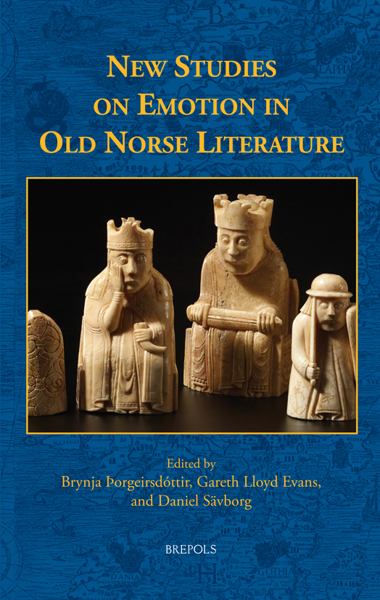
This volume presents thirteen original essays that explore how emotions are represented across a wide spectrum of Old Norse texts. Subjects range from love, sorrow, and humiliation to monstrous feelings, renowned lovers, representations of the mind, curiosity, desire, and many other forms of emotional experience. Reflecting the vibrant scholarly interest in medieval depictions of emotion, this volume brings together diverse methodological approaches and critical perspectives. The contributors examine emotive expression in Eddic and skaldic poetry, rímur, romances, hagiography, medical texts, and runic inscriptions, as well as in major prose genres such as the kings’ sagas, sagas of Icelanders, contemporary sagas, and legendary sagas.
With its wide generic range and diverse critical strategies, this volume significantly broadens the scope of emotion studies in Old Norse literature — a field which was for a long time understudied but has now become a central topic within Old Norse studies. It will be of interest to scholars and students of medieval literature, history, philology, and the history of emotions, as well as to readers intrigued by how premodern texts register and interpret human affect.
zum Buch im ULB-KatalogPlus
zum Buch auf der Verlags-Website
Weitere Titel können Sie in unseren Neuerwerbungslisten für die Philologien im Fach-Cluster Geisteswissenschaften 2 entdecken!
Schreibe einen Kommentar