
In der letzten Zeit sind u.a. diese frei verfügbaren Titel erschienen:
Non-Canonical English Syntax: Concepts, Methods, and Approaches
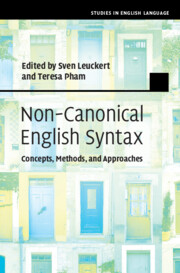
Sven Leuckert & Teresa Pham (Hrsg.)
https://doi.org/10.1017/9781108863858
The term non-canonical syntax generally refers to deviations from ‚typical‘ word order. These represent a fascinating phenomenon in natural language use. With contributions from a team of renowned scholars, this book presents a range of case-studies on non-canonical syntax across historical, register-based, and non-native varieties of English. Each chapter investigates a different non-canonical construction and assesses to what extent it can be called ’non-canonical‘ in a theory-based and frequency-based understanding of non-canonical syntax. A range of state-of-the-art methodologies are used, highlighting that an empirical approach to non-canonical syntactic constructions is particularly fruitful. An introduction, a synopsis, a terminological chapter, and three section introductions frame the case studies and present overviews of the theory behind non-canonical syntax and previous work, while also illustrating open questions and opportunities for future research. The volume is essential reading for advanced students of English grammar and researchers working on non-canonical syntax and syntactic variation.
Pragmatics in Contested Interpretation: Varied Audiences, Varied Implicatures, Varied Inferences
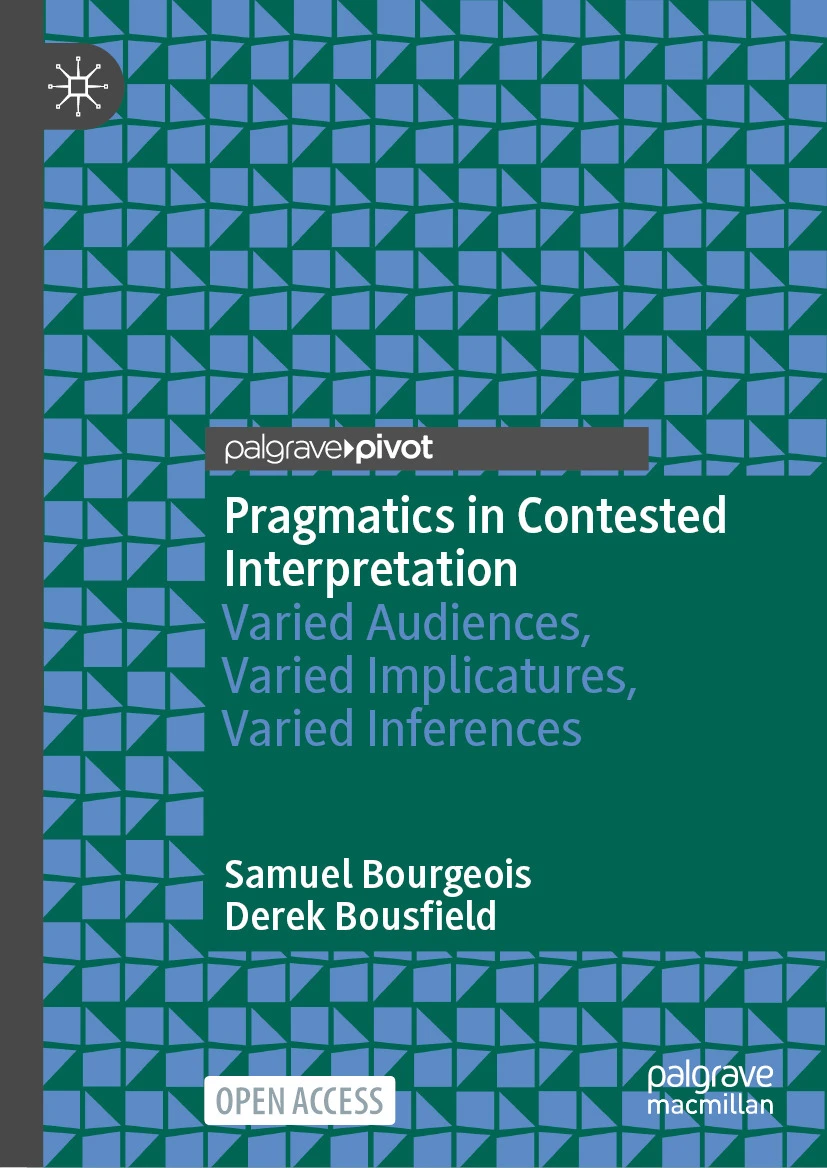
Samuel Bourgeois & Derek Bousfield
https://doi.org/10.1007/978-3-031-95345-3
This open access book explores the mechanisms by which different audiences hearing the same comments made by the same speaker in the same context come to different interpretations as to the meanings behind them. The study uses a ‘pragmacognitive’ approach that fuses insights from sociopragmatics and critical discourse analysis to examine both the speaker’s intentions and the audience’s reactions.
The authors explore the role and construction of context through a pragmacognitive analysis of two controversial utterances made by Donald Trump during the 2020 and 2024 presidential election campaigns and one controversial comment from President Joe Biden’s short-lived 2024 re-election campaign. They analyse in detail how these comments have been interpreted by those receiving their words within the wider political context of a highly politicised and divisive campaign, inferred by some to constitute problematic insulting behaviours and/or calls for violence while others have found them to be playful political critiques. The authors emphasise how indeterminate language, activity type conventions, and the respective identities and reality paradigms of the speakers contribute to creating varied audiences with ‘contested interpretations’. Contested interpretations are particularly apparent in cases where ambiguous, hyperbolic, or even metaphorical language is used to simultaneously conduct face-attack against individuals and organizations, and appeal to a political base of supporters.
This book contributes to the growing body of scholarship in this area and will be of interest to a multidisciplinary audience including readers in linguistics, political rhetoric, and political discourse.
The Subtlety of the Street: The Discourse of Responsibility

M. Peregrine Balmat
https://doi.org/10.3998/mpub.12350324
The Subtlety of the Street examines the effects of small, seemingly mundane words that occur in conversations between street-level workers and those they serve. Combining discourse analysis, public policy studies, and higher education and social work research, M Peregrine Balmat examines data from two distinct ethnographies that comprise over 1100 pages of transcribed social interaction and 24 months of participant observation fieldwork. Balmat uses Interactional Linguistics to examine how responsibility is constructed over time in social work (homeless shelter) and higher education (community college) contexts, bringing to light systemic issues that face street-level disciplines. Analyzing constellations of words—personal pronouns, terms referring to performance benchmarks and assessments, and cultural mythologies—the author shows that clusters of seemingly generic phrases street-level workers use to communicate responsibility can function, in concert, as racialized microaggressions —termed the Gestalt of Responsibility.
These problematic linguistic choices can accumulate over a student’s time in the classroom or over a person’s time in shelter. They shift in response to performance assessments and measurements, increasing in unfriendly, morally-loaded constructions of responsibility as testing days and shelter restrictions approach. While street-level research suggests that strategies like these are utilized because workers believe those discourse practices work, the phrases reflect historical English Poor Laws and racialized ideologies leveled against enslaved Black people as well as more modern neoliberal welfare state and education politics where such ideologies persist. The Subtlety of the Street offers recommendations for street-level workers‘ collaborative professional development and implications for street-level approaches to pedagogy and practice.

Schreibe einen Kommentar