
In der letzten Zeit sind u.a. diese frei verfügbaren Titel erschienen:
The Austronesian languages of eastern Indonesia and Timor-Leste: Unravelling their prehistory and classification
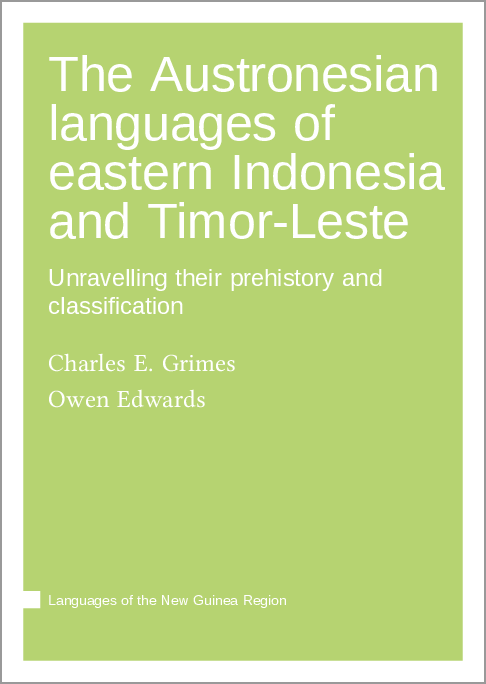
Charles E. Grimes / Owen Edwards
https://langsci-press.org/catalog/book/526
https://doi.org/10.5281/zenodo.18323007
For 150 years there has been a question over how the Austronesian languages of eastern Indonesia and Timor-Leste fit into the Austronesian world. The area is severely under-documented. There has been no consensus on the classification of these languages, and scholars admit to being perplexed. This is the first systematic attempt at subgrouping the whole region based on historical phonology, supplemented by morphosyntax and the lexicon. Insights from archaeology, DNA studies, and awareness of long-term contact with Papuan languages inform this study.
Nine Wallacean subgroups are identified, along with their internal structures. Light is shed on languages whose classification has been unclear. Discontinuities in the historical phonology suggest different groups speaking different Austronesian languages got off different boats at different places, probably at different times. No evidence is found supporting a monolithic Austronesian advance through the region, nor a common Austronesian parent language below PMP that links all Wallacean subgroups.
Speakers of SVO Austronesian languages with prepositions, preverbal negation, numbers before nouns, and post-posed possessors came into contact with speakers of languages of unrelated Papuan families, with postpositions, clause-final negation, numbers following nouns, preposed possessors, and other features of SOV languages. Austronesian languages adopted these features but not uniformly, such that features attributed to contact are uneven across the region. Some are not found in some subgroups or branches within subgroups. Distribution maps of phonological, grammatical, and lexical features show many features are not found in all subgroups, do not align with each other, and some are found outside the region. Austronesian languages in the region are a kind of uneven hybrid that make them typologically different from Austronesian languages to the west and north.
The study evaluates earlier proposals along with new possibilities to link subgroups in different ways, but finds no features or sound changes that are exclusively shared innovations inherited from a common parent. Scenarios are explored of how Austronesian-speaking peoples came into the region. The uneven distribution of various features is addressed. Implications are many, and warrant a revised picture of the Austronesian world.
Several factors enabled this more in-depth study than has been previously possible. Both authors have extensive experience in the region. Many Dutch-era sources have become accessible online. Recent publications and unpublished data have been shared by others. This enabled the authors to glean data from 517 Austronesian and Papuan languages from within the region as well as to the west and east of it, providing context. Within the region, data have been gleaned from 292 varieties (256 Austronesian, 36 Papuan), some of which are now extinct. The volume is data rich with 334 data tables, 77 figures (including 32 maps), and 236 numbered examples/lists of data.
The appendices in .txt format along with select figures and maps can be downloaded from: https://doi.org/10.18710/3CT9RO.
Colonial Vocabularies: Teaching and Learning Arabic, 1870–1970
Sarah Irving, Karène Sanchez-Summerer, Rachel Mairs, Lucia Admiraal (Hrsg.)
https://doi.org/10.1515/9789048560400
Language teaching and learning were crucial to Europeans’ colonial, national, and individual enterprises in the Levant, and in these processes, “Oriental language teachers“ – as they were termed prior to the Second World War – were fundamental. European state nationalisms influenced and increasingly competed with each other by promoting their languages and cultures abroad, by means of both private and governmental actors. At the same time, learning Arabic became more prominent around the Mediterranean. The first half of the twentieth century corresponded with the emergence of new media; language was thought of as a cultural product to be exported into new cultural spaces. However, many blind spots remain in the history of linguistic thought and practices, including the forgotten and neglected voices of those involved in learning and teaching Arabic. This volume aims to revisit aspects of this linguistic encounter, including its vision, profile, priorities, trajectories, and practices.
K-Pop Fandom: Performing Deokhu from the 1990s to Today

Areum Jeong
https://doi.org/10.3998/mpub.12903806
K-Pop Fandom insists that K-pop fan practices and activities constitute a central productive force, shaping not only K-pop’s explosive global popularity, but also K-pop’s cultural impacts, politics, and horizons of possibility. Over the past three decades, the K-pop fandom and its activities have expanded, intensified, and diversified along myriad dimensions, assuming novel social, technological, and economic forms, some of which are unique to K-pop, and some of which reflect broader cultural and industrial logics of globalized mass entertainment culture. Areum Jeong argues that K-pop fans, in performing deokhu—a Korean term connoting an „avid fan“—perform a materialization of affective labor that also seeks to produce good relationships between asymmetrically positioned actors in the K-pop ecosystem.
Through an autoethnography of becoming a K-pop deokhu, Jeong connects their experiences to generations of K-pop fans, showing simultaneously how fandom practices have shifted over time and the intricacies of fan labor participation. This personal connection paved the way for participant-observation and co-performer witnessing methodologies in the study, which crucially allowed for collaborating with fans whose communal pursuits have been stigmatized by dominant discourses that denigrate their activities as solely addictive, uncritical, and wasteful. Jeong’s genre-spanning corpus of fan activities and analyzing its contexts and contents represents an important contribution to the making of a fan archive that is also an archive of affective labor.

Schreibe einen Kommentar