
In der letzten Zeit sind u.a. diese frei verfügbaren Titel erschienen:
Linguistic Representations of Women in Old English Prose: A Corpus-Based Phraseological Study
Anna Cichosz & Tomasz Dobrogoszcz
https://doi.org/10.1017/9781009625791

This Element traces the origins and earliest manifestations of gender bias in the English language. The analysis is based on a corpus of Old English prose texts, written between the ninth and the eleventh centuries. The results are interpreted in the historical, cultural and literary context of Anglo-Saxon England and early medieval Europe. The investigation shows a significant difference in the way women and men are presented in Old English texts, with the former clearly associated with family life, portrayed in the context of their physical appearance, marriage and childbearing, rarely involved in meaningful activities and presented as possessions of their male relatives. Situating the linguistic representations of women in the context of Christianity, the Element demonstrates that late Old English can be seen as a vehicle of language bias that will establish male domination for centuries to come.
The multilingual lexis of the medieval English manor: A trilingual thesaurus
Gloria Mambelli
https://langsci-press.org/catalog/book/524
https://doi.org/10.5281/zenodo.19494857
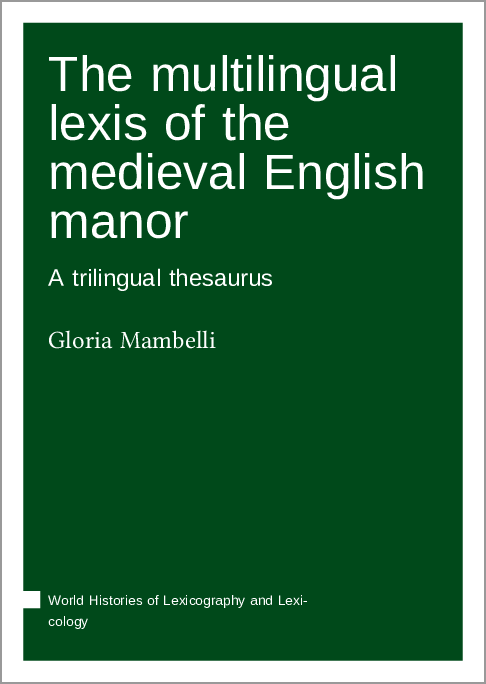
Despite decades of scholarship on lexical borrowing in post-Conquest England, the vocabulary of the medieval countryside has remained largely outside the lens of contact linguistics — an oversight shaped by the long-standing assumption that French influence was confined to elite domains. At the same time, the multilingual reality of medieval England has made monolingual lexicography an increasingly inadequate tool: the Anglo-French, Medieval Latin, and Middle English lexicons of the period cannot be studied in isolation, yet no single trilingual resource has existed to study them together.
This book provides that resource. Drawing on the historical dictionaries of all three languages and grounded in cognitive semantics, it constructs an onomasiological thesaurus of the vocabulary associated with the medieval English manor — concepts and referents attested from 1100 to 1500, arranged in conceptual groupings modelled on the structure of the Historical Thesaurus of English and the Bilingual Thesaurus of Everyday Life in Medieval England.
The findings reframe received assumptions. Language contact shaped the rural lexicon far more deeply than the literature has claimed: French- and Latin-origin vocabulary dominates the terminology of manorial society, while native English holds its ground in the vocabulary of familiar locations. The asymmetry illuminates the social mechanics of borrowing in non-elite environments and carries implications for the history of English into the present day.
This book will be essential reading for specialists in the history of the English language, the history of linguistics, historical lexicology and lexicography, and medieval studies, as well as for historical linguists and advanced students of language contact and multilingualism.
The Superlative Alternation in Present-Day English: Triangulating Elicitation and Usage Data
Nikolai Beland
https://doi.org/10.20378/irb-110919
This dissertation investigates the alternation between synthetic (-est) and analytic (most) superlative forms in English through a two-part empirical study. The first part is based on a large-scale questionnaire examining the influence of social and speaker-related variables such as variety, age, gender, and education, alongside linguistic and complexity-based factors at phonological, syntactic, and pragmatic levels. The study also explores morphosyntactic persistence, assessing how preceding patterns of gradation influence subsequent variant choice. Multifactorial analyses reveal systematic interactions between social and linguistic predictors, supporting the hypothesis that the cognitive facilitation strategy known as more-support (Mondorf 2009) extends to the superlative, while highlighting the limits of a purely complexity-based account.
The second part complements these findings with a corpus-based study grounded in usage-based construction grammar and exemplar-theoretic assumptions. Drawing on the GloWbE corpus (US and GB sections), it examines superlative alternation with focus on the morphophonological properties of the adjective, frequency effects (type and token), un-prefixed adjectives (e.g. happy vs. unhappy), and the processing and representation of complex forms (holistic vs. decomposed). Cross-varietal and comparative analyses reveal usage patterns that contextualize and extend the questionnaire findings.
From a methodological perspective, the dissertation’s central contribution lies in the triangulation of elicitation and usage data, demonstrating how a multimethod approach enriches our understanding of grammatical variation and morphosyntactic alternations. By integrating controlled elicitation with authentic corpus evidence, the study illuminates the cognitive, linguistic, and social mechanisms underlying superlative strategy choice and provides both theoretical and methodological insights for future research on grammatical variation.
Schreibe einen Kommentar