
In der letzten Zeit sind u.a. diese frei verfügbaren Titel erschienen:
The Companion to Digital Humanities in Practice

Constance Crompton, Laura Estill, Richard J. Lane & Ray Siemens (Hrsg.)
https://doi.org/10.4324/9781003327677
The Companion to Digital Humanities in Practice offers international perspectives on how we teach and research in and with digital humanities today.
Building on the foundation of earlier publications that focused on practice in the field, this Companion provides a significant treatment of pertinent issues and contexts, extending breadth and depth, as well as reach, in terms of geographical diversity of topics and contributors. Divided into four sections, each with a high-level practice-oriented focus, the volume covers data; tools and techniques; communication, dissemination, and engagement; and pedagogical practices. Contributors to the volume include both established and emerging scholars. Foregrounding and critically reviewing the emergence and development of standards-based communities of practice, the Companion provides an overview of core competencies; conceptualized case studies; and links to further reading, training materials, and exercises.
The Companion to Digital Humanities in Practice will appeal to academics, researchers, and postgraduate students working in DH, literary studies, history, and the humanities more broadly. It should also be of interest to professionals working in DH and galleries, libraries, archives, and museums.
Digital editing and publishing in the twenty-first century
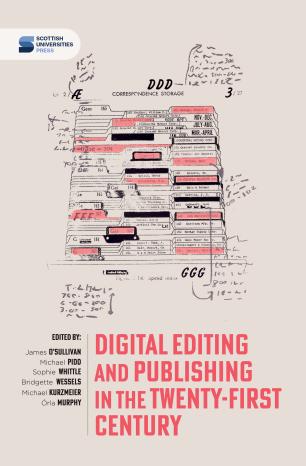
James O’Sullivan, Michael Pidd, Bridgette Wessels, Órla Murphy, Michael Kurzmeier, Sophie Whittle (Hrsg.)
https://doi.org/10.62637/sup.GHST9020
Writing in 2016, Joris van Zundert called on theorists and practitioners to intensify the methodological discourse necessary to implement a form of hypertext that truly represents textual fluidity and text relations in a scholarly viable and computationally tractable manner. Without that dialogue, he warned, we relegate the raison d’être for the digital scholarly edition to that of a mere medium shift, we limit its expressiveness to that of print text, and we fail to explore the computational potential for digital text representation, analysis, and interaction. While such a dialogue has begun in earnest, digital scholarly editing and publishing remain rooted in the cultural and structural logics of print.
Digital editing and publishing in the twenty-first century collects a range of perspectives on the current state and future of digital editing and publishing, in an effort to further that dialogue and encourage continued exploration of how we make and share knowledge and meaning in the digital age.
The collection engages with timely and important topics which are often neglected, including queer approaches to editing, accessibility, editing and publishing in the age of artificial intelligence, and the data edition.
Early Modern Translation and the Digital Humanities
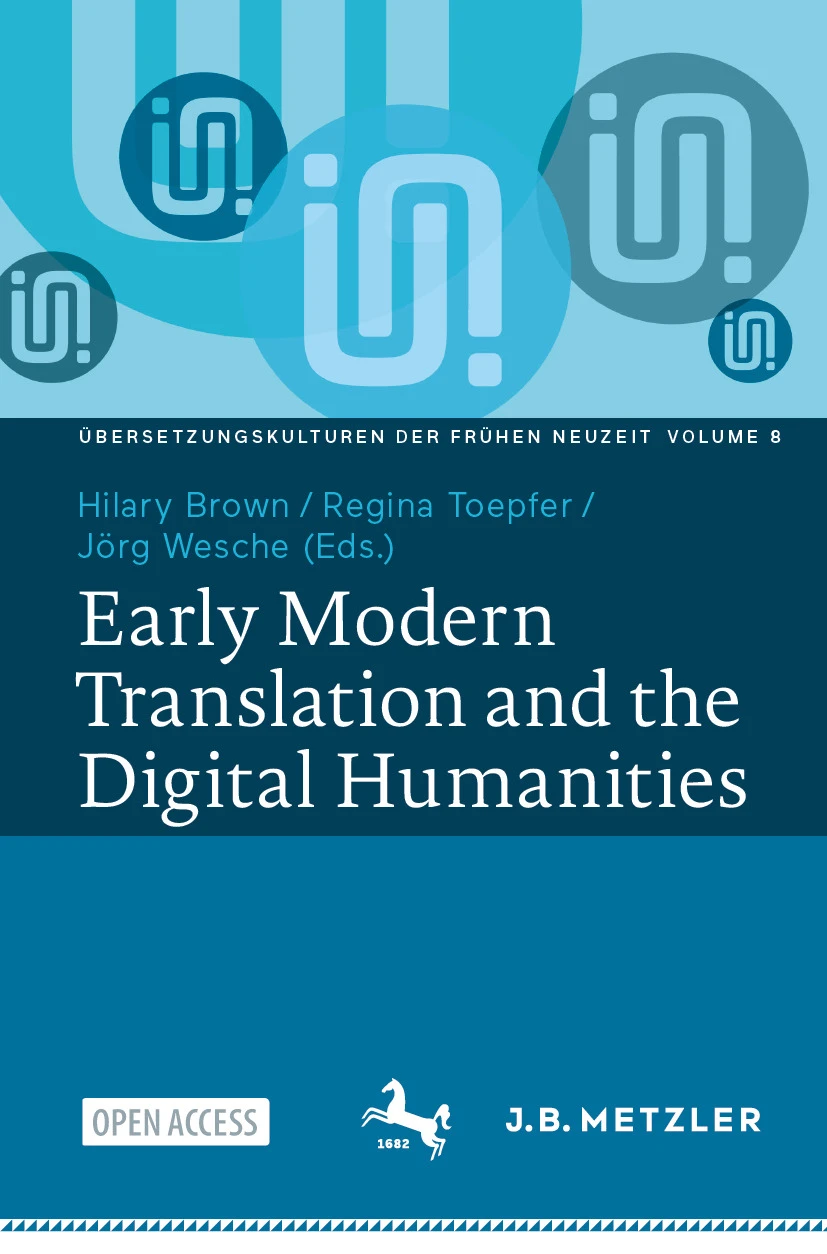
Hilary Brown, Regina Toepfer, Jörg Wesche (Hrsg.)
https://doi.org/10.1007/978-3-662-70483-7
This open-access volume explores how digital resources and methods can be usefully employed for research on early modern translation. The volume focuses mainly on digital resources, and features a number of chapters on translation-specific resources written by members of the teams leading the projects. The resources presented here encompass translations into and/or out of Greek, Latin, the European vernaculars, and Jewish languages (Hebrew, Yiddish, Ladino and Judeo-Italian) and different corpora including plays, encyclopedias, and ‘radical’ texts. While the use of digital methods to analyse early modern translations is still in its early stages, the volume also considers how methods such as data visualisation could shed new light on translation phenomena.
Schreibe einen Kommentar