

In der letzten Zeit sind u.a. diese frei verfügbaren Titel erschienen:
Decolonizing Linguistics
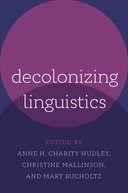
Anne H. Charity Hudley, Christine Mallinson & Mary Bucholtz (Hrsg.)
https://doi.org/10.1093/oso/9780197755259.001.0001
Decolonizing Linguistics, the companion volume to Inclusion in Linguistics, is designed to uncover and intervene in the history and ongoing legacy of colonization and colonial thinking in linguistics and related fields. The volume’s introduction theorizes decolonization as a process of centering Black, Native, and Indigenous perspectives, describes the extensive dialogic and collaborative process through which the volume was developed, and then lays out key principles of decolonizing linguistic research and teaching.
The 20 chapters cover a wide range of languages and linguistic contexts (e.g., Bantu languages, Creoles, Dominican Spanish, Francophone Africa, Zapotec) as well as various disciplines and subfields (applied linguistics, communication, historical linguistics, language documentation and revitalization/reclamation, psycholinguistics, sociolinguistics, syntax). Contributors address such topics as being transparent about the political nature of all linguistic research; exposing colonial and racist thought in psycholinguistics; refusing settler-colonial practices and centering community goals in research on Indigenous languages; amplifying the liberatory tradition of Caribbean linguistics; confronting minoritization as a racialized applied linguist in Europe; anti-Blackness in French linguistics; teaching linguistics and communication through a decolonial and antiracist lens; decolonizing research partnerships between the Global South and the Global North; envisioning anticolonial Open Methods in linguistics; decolonizing research on Creoles; prioritizing Black Diasporic perspectives in linguistics; and challenging deficit approaches to linguistic variation in communication curricula.
The volume’s conclusion lays out specific actions that linguists can take through research, teaching, and institutional structures to refuse coloniality in linguistics and to move the field toward a decolonized future.
Grammatical systems without language borders: Lessons from free-range language
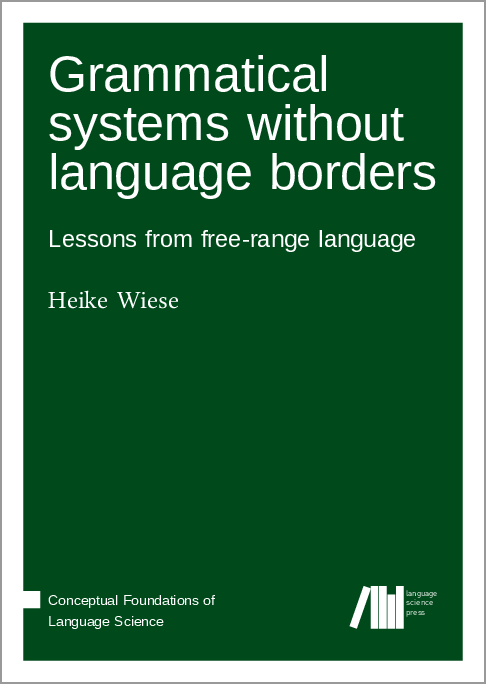
Heike Wiese
https://langsci-press.org/catalog/book/423
https://doi.org/10.5281/zenodo.10276182
Current research in grammatical analysis and sociolinguistics points to two core characteristics of language that seem incommensurable at first sight: (1) research on linguistic structure indicates internal organisation and coherence, and the workings and interactions of distinct grammatical systems, but (2) sociolinguistic research suggests that language borders and bound ‘languages’ are counterfactual social constructs that cannot capture the diversity and fluidity of actual language use. This seems to constitute something like a “quantum-linguistic” paradox: language systems aren’t real (they are just ideological constructions), but at the same time, they are a reflection of actual structure.
This book shows how this paradox can be resolved through an architecture that allows for grammatical systems without presupposing language borders: this architecture puts communicative situations, rather than languages, at the core of linguistic systematicity, while named languages are captured as optional sociolinguistic indices. The approach builds on insights from “free-range” language, a metaphor for language in settings that are less confined by monoglossic ideologies. The author looks at four different kinds of settings: urban markets, heritage language settings, multiethnic adolescent peer-groups, and digital social media.
Central lessons to be learned from such free-range language settings are: (1) communicative situations support linguistic differentiation and can thus be the basis for fluid registers; (2) grammatical systematicity is grounded in communicative situations and does not require bound languages and linguistic borders; (3) named ‘languages’ can emerge as social indices signalling belonging, but this is an optional, not a necessary development.
New perspectives in interactional linguistic research
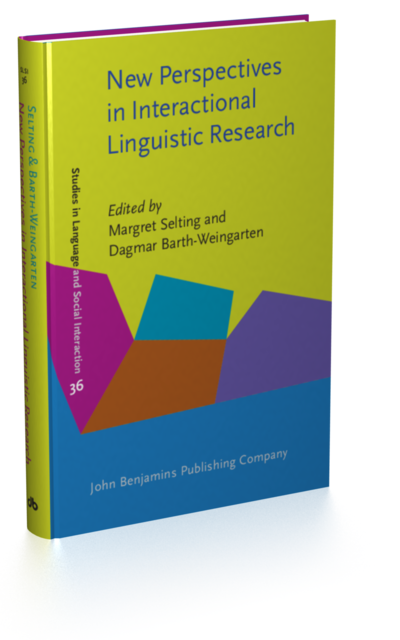
Margret Selting & Dagmar Barth-Weingarten (Hrsg.)
https://benjamins.com/catalog/slsi.36
This collection of original papers illustrates recent trends and new perspectives for future research in Interactional Linguistics (IL). Since the research program was started around the turn of the century, it has prospered internationally. Recently, however, new developments have opened up new perspectives for interactional linguistic research.
IL continues to study the details of talk in social interaction, with a focus on linguistic resources and structures of verbal and vocal interaction in bodily-visible interactional settings. Increasingly, though, it embraces methods supported by new technology and broadens its data and research questions to applications in teaching, therapy, etc.
The volume comprises three parts with 14 contributions: (1) Studying linguistic resources in social interaction; (2) Studying linguistic resources in embodied social interaction; and (3) Studying social interaction in institutional contexts and involving speakers with specific proficiencies.


Schreibe einen Kommentar