
In der letzten Zeit sind u.a. diese frei verfügbaren Titel erschienen:
Angewandte Linguistik für Sprachberufe
ZHAW School of Applied Linguistics ZHAW School of Applied Linguistics
https://doi.org/10.1515/9783110786750
Der Band führt ein in Angewandte Linguistik für Sprachberufe. Er fördert wissenschaftlich fundiertes Denken und Handeln in einem Berufsalltag, der immer stärker mitgestaltet wird von künstlicher Intelligenz. Diese 4. Auflage enthält neue und aktualisierte Übungsmaterialien zur erweiterten Illustration, Dokumentation und Reflektion bestehenden Grundwissens.
Die Kapitel erkunden übergreifende linguistische Zusammenhänge aktueller Sprachberufe in Journalismus, Organisationskommunikation, Übersetzen und Dolmetschen sowie in der sprachlichen Integration. Durch das Lesen, Lernen und Üben mit diesem Buch und dem dazu gehörenden Online-Angebot wird ein Bewusstsein dafür geschaffen, wo Menschen der künstlichen (Sprach-)Intelligenz überlegen sind.
Griffige theoretische Überlegungen und Fallbeispiele regen dazu an, gesellschaftlich bedeutsame Fragen aus linguistischer Perspektive zu stellen und Praxisprobleme wissenschaftlich überlegt zu erfassen und anzugehen. Auf diese Weise unterstützt der Band Interessierte dabei, sich kurzfristig und auf Dauer in ihrem Sprachberuf zu verbessern.
Weitere Übungsaufgaben finden sich auf der begleitenden Website: https://language-matters.education/.
An Introduction to Quantitative Text Analysis for Linguistics: Reproducible Research Using R

Jerid Francom
https://doi.org/10.4324/9781003393764
An Introduction to Quantitative Text Analysis for Linguistics: Reproducible Research Using R is a pragmatic textbook that equips students and researchers with the essential concepts and practical programming skills needed to conduct quantitative text analysis in a reproducible manner. Designed for undergraduate students and those new to the field, this book assumes no prior experience with statistics or programming, making it an accessible resource for anyone embarking on their journey into quantitative text analysis.
Through a pedagogical approach which emphasizes intuitive understanding over technical details, readers will gain data literacy by learning to identify, interpret, and evaluate data analysis procedures and results. They will also develop research skills, enabling them to design, implement, and communicate quantitative text analysis projects effectively. The book places a strong emphasis on programming skills, guiding readers through interactive lessons, tutorials, and lab activities using the R programming language and real-world datasets.
This practical textbook is enriched with features that facilitate learning, including thought and practical exercises, a companion website that includes programming demonstrations to develop and augment readers’ recognition of how programming strategies are implemented, and a GitHub repository that contains both a set of interactive R programming lessons and lab exercises, which guide readers through practical hands-on programming applications. This textbook is an essential companion to any linguist looking to learn how to incorporate quantitative data analysis into their work.
Teaching translation in the age of generative AI: New paradigm, new learning?
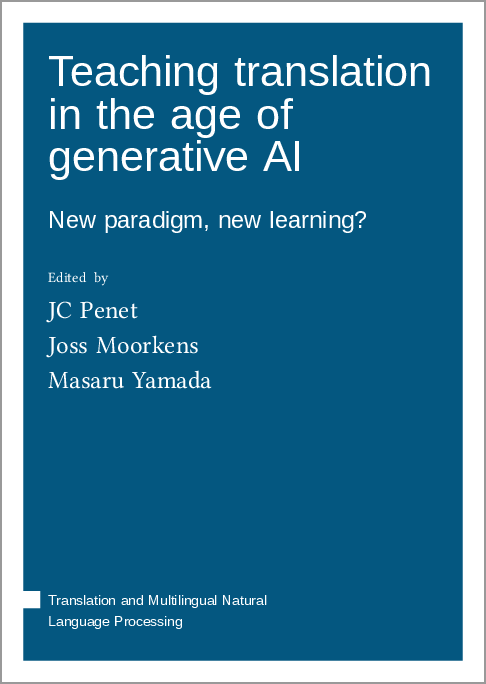
JC Penet, Joss Moorkens & Masaru Yamada (Hrsg.)
https://langsci-press.org/catalog/book/520
https://doi.org/10.5281/zenodo.17580856
Since the launch of OpenAI’s ChatGPT in 2022, generative artificial intelligence (GenAI) has started reshaping what it means to work as a professional translator in an industry that is becoming increasingly automated. This prompts us to interrogate, once again, the role and agency of human translators in the translation process or, in other words, the intrinsically human value and values they add to it. A natural corollary is that GenAI forces us translator educators to (re-)interrogate what we do in our translation programmes. Whatever we may think or feel about GenAI, we owe it to our students to engage with it in our programmes. However, because GenAI is not just another tool in the translator’s toolkit, we must also to do so in a way that raises students’ awareness of some of the ethical and sustainability issues around it.
This is what Teaching Translation in the Age of Generative AI: New Paradigm, New Learning aims to do. Articulated around three main parts, Part 1 explores the new skills and competences translator educators need to help their students develop in the age of GenAI. In Part 2, the focus shifts to the new knowledge (such as data literacy and prompting) that students in translation programmes need to engage with in the age of GenAI. Finally, Part 3 puts some flesh on the bones, as it reviews some of the new teaching approaches adopted by colleagues since the advent of GenAI. It does so by introducing the reader to a series of vignettes taken from a variety of translation-related disciplines and contexts.
Throughout the entire edited volume, the ambition is to be as accessible as possible, so that this volume can be of help to as many of us in translation education as possible, as we all learn to negotiate the uncharted territory of GenAI.
Schreibe einen Kommentar